
Head of Department: Mrs Cathy Tang Hales
Email: [email protected]
People often ask me ‘What is Economics about?’ It is about weighing different choices or alternatives. Some of those important choices involve money, but many do not. Decisions such as should I go to university or start working, should I buy a new car or save money to do a Master’s degree or how can I best reduce the amount of plastic that I use and buy are all economic decisions. Economics is also about examining why consumers, businesses, governments and banks don’t make what seem like the most economizing or efficient choices.
Economics is a wide-ranging subject and it has an influence on, and is influenced by, a number of other subjects, including Politics, Philosophy, Maths, Geography and History. It is based on a discrete body of thought using theory and concepts as well as facts and figures. In this sense, Economics could be thought of as more like a science than a humanities subject. This sometimes abstract nature causes Economics to be classified as a “difficult” subject, but those students who are curious to examine current events from a scientific perspective should find it particularly appealing.
Economics is a topical course which means that success requires the regular reading of the quality press and the watching of relevant television programmes. No prior knowledge of the subject is assumed and Economics combines well with many other subjects. Some students will go on to take the subject to degree level but many will find that they are able to study some Economics in courses such as Business Studies or Mathematics. Above all, Economics provides students with the tools that are vital to success in many other subjects and careers.
Entry Requirements
The mathematical content of the course is moderately rigorous for HL Economics and students should study either standard or higher level Mathematics. For SL Economics, a grade C at GCSE Maths should allow access to the course. However, it should be noted that some universities either require, or strongly prefer, students wishing to study Economics to have studied Mathematics HL. Have a close look at the university websites or make contact directly with international universities to make absolutely sure.
Course Objectives
By the end of the course students should be able:
Course Outline
There are four sections in the IB Economics course.
Introduction to Economics-This section of the course examines the nature of economics and its role as a social science. Students will investigate Economic models of decision making and how past and modern economists have shaped economic theory since the 18th century. An exploration of concepts such as scarcity and choice are central to economic theory. Students will learn about how these concepts link to the dilemma that societies face and the trade-offs that need to be made especially in regards to the challenge of sustainability. Students will learn to appreciate the potential conflicts between economic growth and equity and between free markets and government intervention that exist in many countries.
Microeconomics - This part of the course examines markets, looking at how they work and why they fail. HL students will also study some Industrial Economics.
Macroeconomics - This section examines economy-wide issues, such as unemployment, economic growth and inflation. Government policy to address macroeconomic issues will also be looked at in detail.
The Global Economy - This section provides an explanation of why countries trade, how exchange rates are set and protection issues. It will also enable students to understand why some countries are less developed than others, the problems these countries face and possible solutions.
Assessment
Email: [email protected]
People often ask me ‘What is Economics about?’ It is about weighing different choices or alternatives. Some of those important choices involve money, but many do not. Decisions such as should I go to university or start working, should I buy a new car or save money to do a Master’s degree or how can I best reduce the amount of plastic that I use and buy are all economic decisions. Economics is also about examining why consumers, businesses, governments and banks don’t make what seem like the most economizing or efficient choices.
Economics is a wide-ranging subject and it has an influence on, and is influenced by, a number of other subjects, including Politics, Philosophy, Maths, Geography and History. It is based on a discrete body of thought using theory and concepts as well as facts and figures. In this sense, Economics could be thought of as more like a science than a humanities subject. This sometimes abstract nature causes Economics to be classified as a “difficult” subject, but those students who are curious to examine current events from a scientific perspective should find it particularly appealing.
Economics is a topical course which means that success requires the regular reading of the quality press and the watching of relevant television programmes. No prior knowledge of the subject is assumed and Economics combines well with many other subjects. Some students will go on to take the subject to degree level but many will find that they are able to study some Economics in courses such as Business Studies or Mathematics. Above all, Economics provides students with the tools that are vital to success in many other subjects and careers.
Entry Requirements
The mathematical content of the course is moderately rigorous for HL Economics and students should study either standard or higher level Mathematics. For SL Economics, a grade C at GCSE Maths should allow access to the course. However, it should be noted that some universities either require, or strongly prefer, students wishing to study Economics to have studied Mathematics HL. Have a close look at the university websites or make contact directly with international universities to make absolutely sure.
Course Objectives
By the end of the course students should be able:
- To understand and apply essential terminology
- To present economic arguments in a clear and logical manner
- To understand and interpret economic data and information
- To appreciate the diverse nature of world economics
- To acknowledge the role of economic institutions in domestic and international settings
- To perceive that economic variables are interrelated and predict possible consequences arising from changing variables
- To apply economic theory to diverse global events in order to analyse and evaluate possible outcomes
Course Outline
There are four sections in the IB Economics course.
Introduction to Economics-This section of the course examines the nature of economics and its role as a social science. Students will investigate Economic models of decision making and how past and modern economists have shaped economic theory since the 18th century. An exploration of concepts such as scarcity and choice are central to economic theory. Students will learn about how these concepts link to the dilemma that societies face and the trade-offs that need to be made especially in regards to the challenge of sustainability. Students will learn to appreciate the potential conflicts between economic growth and equity and between free markets and government intervention that exist in many countries.
Microeconomics - This part of the course examines markets, looking at how they work and why they fail. HL students will also study some Industrial Economics.
Macroeconomics - This section examines economy-wide issues, such as unemployment, economic growth and inflation. Government policy to address macroeconomic issues will also be looked at in detail.
The Global Economy - This section provides an explanation of why countries trade, how exchange rates are set and protection issues. It will also enable students to understand why some countries are less developed than others, the problems these countries face and possible solutions.
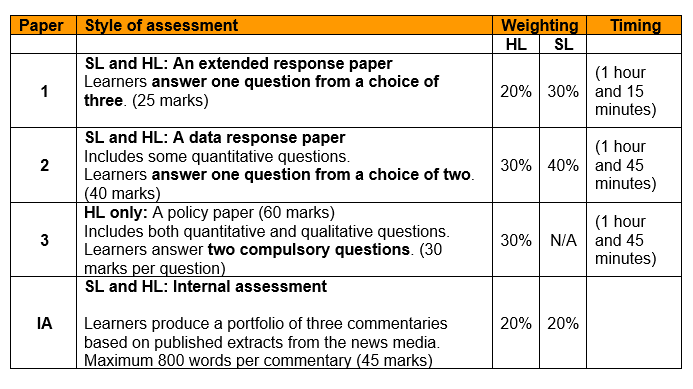
Assessment
Future Pathways
Students who study IB Economics have access to a wide range of career and higher education opportunities. By the end of the course students will have learned how to evaluate and analyse information, how to weigh up evidence and how to communicate complex ideas effectively. These skills are recognised and valued by employers, universities and colleges. IB Economics provides an excellent foundation for a number of popular careers including Finance, Banking, Business and Law.
Students who study IB Economics have access to a wide range of career and higher education opportunities. By the end of the course students will have learned how to evaluate and analyse information, how to weigh up evidence and how to communicate complex ideas effectively. These skills are recognised and valued by employers, universities and colleges. IB Economics provides an excellent foundation for a number of popular careers including Finance, Banking, Business and Law.
